The world’s oldest secret society has a TikTok account. But is the charming, Nando’s-loving, techno-dancing version of Freemasonry they’re selling to Gen Z the full picture — or just a carefully curated illusion?
Introduction: The Great Freemason Rebrand
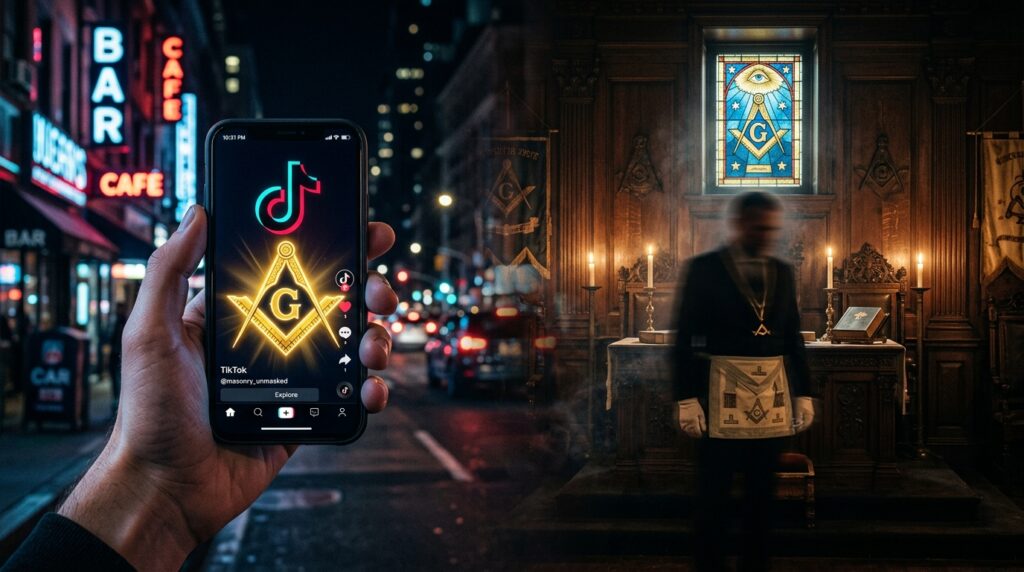
For centuries, the Freemasons have been the ultimate symbol of secrecy. Kings, statesmen, and explorers have walked through their doors. Their rituals, handshakes, and symbols have fueled countless conspiracy theories. But in 2025, something unprecedented happened: the Freemasons went viral on TikTok.
The London Freemasons TikTok account has amassed over 43,000 followers — a remarkable figure for an organisation that spent three centuries operating in the shadows. Their videos show members trading grand dinners for Nando’s, dancing to techno music, and producing their own grime tracks. They post “explainer” videos claiming their infamous handshake is not a “cloak-and-dagger mystery” but a “purely ceremonial” gesture representing “trust, unity and the values of fraternity”.
“Cool is generous,” says Luke Nutkins, a 36-year-old member. “I don’t think it’s trendy. [But] it has a coolness about it.”
The message to young people is clear: We’re not a secret society. We’re a community. We’re about friendship, charity, and personal growth. Join us.
But is that the whole truth? Or is there a gap between the TikTok-friendly image and the reality of what Freemasonry actually represents in 21st-century Europe?
What the TikTok Videos Actually Show
Before we examine the gap between image and reality, let’s look at what the Freemasons are actually telling young people on social media.
The “We’re Just a Social Club” Narrative
The London Freemasons’ TikTok account features:
- Meme videos making fun of their own traditions — from lambskin aprons and white gloves to their love of the national anthem
- Behind-the-scenes clips showing lodge interiors and ceremonies
- Explainer videos where members describe the organisation’s “Four Cardinal Virtues”: Temperance, Fortitude, Prudence, and Justice
- Lifestyle content showing lavish dinners, skiing trips, and Christmas parties
One media secretary explains in a clip that Freemasonry is “not a religion” but designed to “sit alongside” faith.
The Connaught Club, a London lodge for under-35s that has been hosting meetings since 2007, has its own social media presence and describes itself simply as a place for young men seeking “connection”.
The “We’re Just Like You” Strategy
The rebrand extends beyond TikTok. For the first time in centuries, lodges are:
- Opening their doors to the public for guided tours
- Advertising at galas, fetes, markets, and agricultural shows
- Hiring PR firms and maintaining active social media accounts
- Running Facebook ad campaigns to attract new members
The United Grand Lodge of England (UGLE) has abandoned the old expectation that men must “knock at the door” unprompted.
The message is one of openness, inclusivity, and modernity. But scratch beneath the surface, and a very different picture emerges.
The Reality Check: What They Don’t Tell You on TikTok
1. The Membership Crisis They’re Desperately Trying to Solve
Here’s the uncomfortable truth the TikTok videos don’t mention: Freemasonry is in decline.
According to UGLE’s own figures, membership has fallen from around 225,000 in 2008 to roughly 170,000 today. In less than two decades, nearly a quarter of British Freemasons have disappeared. For the past decade, there has been a 2.5% drop in members every year. The average age is estimated to be 60, with members literally dying off. About 17% of new initiates leave within three years; for some lodges, the figure is 30%.
As The Observer reported, one observer described the PR drive as “a sign of panic”. The Freemasons aren’t opening up because they want to — they’re opening up because they have to.
The TikTok strategy isn’t about transparency for its own sake. It’s about survival. And that context matters when evaluating what they’re telling young people.
2. The Catholic Church Says Membership Is Incompatible with Christianity
You won’t find this on TikTok: the Catholic Church has just issued one of its clearest ever statements on Freemasonry.
In June 2026, the Nordic Bishops’ Conference — covering Denmark, Finland, Iceland, Norway, and Sweden — issued a pastoral letter stating that there are no exceptions: membership in a Masonic lodge remains incompatible with the Catholic faith.
The bishops explicitly rejected the interpretation that Scandinavian branches of Freemasonry differed so substantially that Catholics could belong to them without contradicting Church teaching.
Catholics who belong to Masonic lodges are urged to renounce their membership and refrain from receiving the sacraments until they do so. Anyone seeking to enter the Catholic Church must first withdraw from any Masonic affiliation.
The bishops were careful to distinguish between judging individuals and judging ideas — but they made clear that Freemasonry proposes a philosophical and spiritual framework that cannot be reconciled with Christian understanding.
This isn’t a fringe view. It’s the official position of the Catholic hierarchy, reaffirmed in consultation with the Vatican’s Dicastery for the Doctrine of the Faith during the bishops’ plenary assembly in Rome in September 2025. The Vatican confirmed in November 2023 that Catholics are forbidden from joining Masonic lodges, with the Dicastery reiterating that “active membership in Freemasonry by a member of the faithful is prohibited, because of the irreconcilability between Catholic doctrine and Freemasonry”.
3. The Handshake Isn’t Just “Ceremonial” — It’s About Loyalty and Secrecy
The TikTok videos present the Masonic handshake as a harmless tradition. But the reality is more complex.
At the heart of Masonic ritual are the “Three Degrees” — a progression that involves:
- Oaths taken with one’s hand on the Bible (or “Volume of Sacred Law”)
- Promises to help fellow Masons and obey the laws of the lodge
- Commitments to principles such as morality and virtue
It was not until 1987 that “beheading and ripping out the tongue” were officially struck from the books as punishments for revealing secrets. “It has upset some people who got squeamish about it,” a Masonic source said at the time. “The obligations will remain, but not the penalties”.
The obligations remain. The secrecy remains. The loyalty to fellow Masons remains. And that’s precisely what concerns public institutions across Europe.
Freemasonry and Public Office: The European Reality
This is where the gap between the TikTok image and reality becomes most stark. If Freemasonry is “just a social club,” why are police forces, courts, and governments so concerned about their members’ involvement?
The UK: The Metropolitan Police vs. The Freemasons
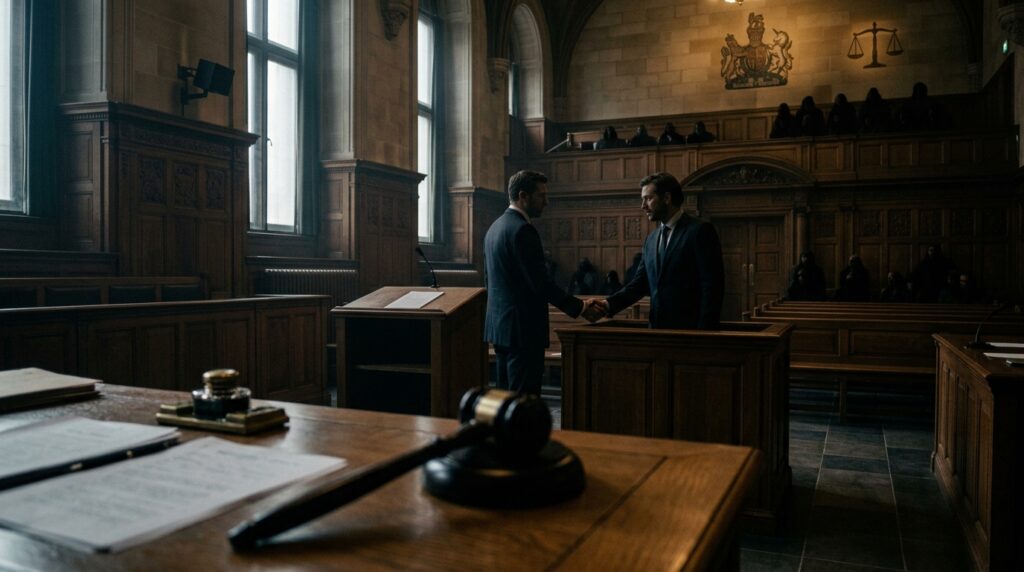
In December 2025, the Metropolitan Police announced that officers and staff would be required to declare membership of the Freemasons — past or present.
The policy applies to any organisation that is “hierarchical, has confidential membership and requires members to support and protect each other”.
The Freemasons fought back. The United Grand Lodge of England (UGLE), along with two serving police officers and other Masonic bodies, launched a legal challenge. They claimed the policy was:
- Discriminatory
- “Unduly stigmatising”
- A violation of their human rights
- An “institutional signal of suspicion” that created a “black list”
They lost.
In February 2026, Mr Justice Chamberlain threw out the legal challenge. In a 17-page ruling, he stated that the Met’s decision “serves a legitimate aim, maintaining and enhancing public trust in policing, and is proportionate”.
The judge said the policy was not discriminatory or “unduly stigmatising” against Freemasons. Leaving the decision to individual officers on an “ad hoc basis” would not “achieve the object of maintaining or enhancing public trust”.
397 Met officers and staff have already declared membership of such organisations — the majority of them Freemasons.
The Met’s Commander Simon Messinger made the reasoning clear:
“Both victims of crime and those reporting wrongdoing must have trust and confidence there is no risk that investigations are tainted by such issues. We have prioritised this over any organisation’s desire to maintain secrecy“.
The Freemasons confirmed they would not appeal the High Court ruling, stating that while they believed the judgment contained “legal and factual errors”, an appeal “would not be in the best interests of Freemasonry”.
Why the Concern? A History of Suspicion
The Met’s concern isn’t new. The relationship between police officers and Freemasons has been a major issue since the 1960s.
- A 2021 report noted that police officers’ membership of the Freemasons had been “a source of recurring suspicion and mistrust in the investigations”
- Allegations of corrupt and unfair patronage through Freemasonry within the police service first emerged in the 1890s
- A 2014 investigation revealed that “secret networks of Freemasons have been used by organised crime gangs to corrupt the criminal justice system”
- Since 1998, it has been compulsory for judges and magistrates to register Masonic membership
“Historically, Freemasons in policing have always been a bit of an issue,” one former senior police source told the BBC.
The core concern has always been the same: Freemasons have held informal but powerful influence over senior police officers who were also members of lodges.
Italy: The European Court of Human Rights Weighs In
The UK isn’t alone in grappling with the Masonic question.
The Grand Orient of Italy took a case to the European Court of Human Rights (ECHR). The case concerned a search of a Masonic association’s premises ordered by a parliamentary inquiry into organised crime.
During the search, authorities seized documents containing the personal data of more than 6,000 members.
The Grand Chamber hearing took place in November 2025. The case raises fundamental questions: Is the secrecy of mere membership of a Masonic lodge legitimate? Can public authorities investigate Masonic associations without violating human rights?
The case — Grande Oriente d’Italia v. Italy — concerns a search ordered in the context of an investigation into the relationship between the Mafia and Freemasonry and the potential Mafia infiltration of Masonic lodges.
The Fundamental Question
As one academic put it:
“How far can membership in a Masonic lodge be regarded as incompatible with the exercise of a public office? Is there any place for a secretive organization in a society demanding transparency?”
The TikTok videos don’t answer this question. They don’t even acknowledge it.
What Young People Are Really Being Sold
When young people scroll through the London Freemasons’ TikTok feed, they see:
- Fun, relatable content
- A community of like-minded individuals
- Opportunities for friendship and networking
- A chance to be part of something bigger than themselves
What they don’t see:
- The membership crisis driving the recruitment push
- The Catholic Church’s clear teaching that Masonic membership is incompatible with Christianity
- The decades of suspicion from police forces and governments
- The legal battles over whether Masonic membership should be declared in public office
- The obligations of secrecy and loyalty that go far beyond a “ceremonial” handshake
One commentator on TikTok called it an “upmarket boys club”. But the reality is more complex — and more troubling.
This investigation into the TikTok rebrand is just one piece of a much larger puzzle unfolding across the continent. To understand how these tensions play out in other jurisdictions—from the legal challenges facing the Grand Orient of Italy to the varying stances of national governments on Masonic transparency—be sure to read our comprehensive analysis of Freemasonry in Europe. For a foundational look at the organization’s centuries-old history, its core rituals, and the very symbols that fuel this modern secrecy debate, explore our complete guide to Freemasonry. Finally, if the high-stakes battle between the Metropolitan Police and the Freemasons caught your attention, you won’t want to miss the latest coverage on our homepage, where we track the most pressing institutional clashes between institutional secrecy and public accountability.
Frequently Asked Questions
1. Is Freemasonry a secret society?
The Freemasons say no. Luke Nutkins, a young member, told the Evening Standard: “I don’t think so”. They prefer the term “society with secrets.”
The reality: They have secret handshakes, secret rituals, secret oaths, and confidential membership. Public institutions across Europe have expressed ongoing concerns about the implications of this secrecy, particularly for those in positions of power.
2. Can Catholics be Freemasons?
No. The Catholic Church has made this clear for centuries. In June 2026, the Nordic Bishops’ Conference reaffirmed that there are no exceptions — membership in a Masonic lodge remains incompatible with the Catholic faith. The Vatican’s Dicastery for the Doctrine of the Faith confirmed in November 2023 that “active membership in Freemasonry by a member of the faithful is prohibited”. Catholics who join are urged to renounce their membership and refrain from receiving the sacraments.
3. Do Freemasons control the government?
There is no evidence of coordinated Masonic control over government. However, the perception of Masonic influence has persisted for decades. As one analysis noted: “No peer-reviewed studies or institutional investigations have shown that they exert coordinated political or economic power.” The concern is more about informal influence, patronage, and conflicts of interest — particularly in policing and the judiciary.
4. Why are the Freemasons on TikTok?
Because they’re struggling to survive. Membership has fallen from 225,000 in 2008 to around 170,000 today. The average age is 60. They’re losing about 2.5% of their members every year. The TikTok campaign is a desperate recruitment drive disguised as transparency.
5. Do police officers have to declare if they’re Freemasons?
In the UK, yes. Since December 2025, Metropolitan Police officers and staff have been required to declare membership of the Freemasons or similar “hierarchical” organisations. A legal challenge by the Freemasons was thrown out by the High Court in February 2026. Around 400 officers have already made declarations.
6. Are women allowed to be Freemasons?
It depends on the lodge. The vast majority of the 7,000 lodges governed by the UGLE in England and Wales are male-only. However, two lodges admit women, and there are separate female Masonic organisations such as the Order of Women Freemasons, which has approximately 4,000 members in more than 300 Craft Lodges. The Honourable Fraternity of Ancient Freemasons (HFAF) is another women’s Masonic organisation.
7. What do Freemasons actually believe?
Freemasonry is not a religion — members describe it as a system of moral philosophy that can “sit alongside” faith. Members progress through three degrees based on the Biblical story of the building of Solomon’s Temple. The core principles are Brotherly Love, Relief (charity), and Truth. However, the Catholic Church argues that Freemasonry proposes a philosophical and spiritual framework that cannot be reconciled with Christian understanding.
8. Are there Freemasons in other European countries?
Yes. Freemasonry is active across Europe. The UGLE governs lodges in England, Wales, and the Channel Islands. There are large Masonic communities in France, Germany, Italy, Spain, and Switzerland. The European Court of Human Rights has heard multiple cases involving Masonic associations.
Conclusion: What’s the Verdict?
Is Freemasonry what they tell young people they are on TikTok?
Yes and no.
Yes, they are a community that offers friendship, networking, and a sense of purpose. Yes, many members are genuinely committed to charity and personal development.
But no, they are not “just a social club.” They are a secretive organisation with a long history of influence in public institutions — influence that has repeatedly raised concerns about corruption, patronage, and conflicts of interest. They are an organisation that the Catholic Church explicitly says is incompatible with Christianity. And they are an organisation that is so desperate for new members that they’ve abandoned centuries of tradition to chase Gen Z on TikTok.
The question isn’t whether Freemasonry has “finally become cool”. The question is whether young people are getting the full picture — or just the carefully curated version that makes them want to join.
The TikTok videos show you the Nando’s, the techno music, and the “ceremonial” handshakes. They don’t show you the legal battles, the Vatican declarations, or the centuries of suspicion.
That’s not transparency. That’s marketing.
And marketing, as any savvy TikTok user knows, is not the same as truth.
What do you think? Have the Freemasons done enough to earn your trust — or does the secrecy still bother you? Share your thoughts in the comments below.